Gold Breaks $5,000: What It Means for Small Finances (and How to Protect Yourself)

Gold has always been seen as a “safe” asset — something people run toward when the world feels uncertain. But this weekend, something huge happened:

Gold crossed $5,000 per ounce.

That number is not just a headline. It’s a warning signal, and also an opportunity — depending on how you respond.

If you manage a small budget, support a family, or live paycheck-to-paycheck, this matters more than many people realize. Let’s break down what it means in plain language and what you can do to protect your finances.


Why Gold Going Over $5,000 Is a Big Deal

When gold skyrockets, it usually means people are losing confidence in something else — often:

  • paper currencies weakening
  • inflation staying stubbornly high
  • stock markets becoming unstable
  • geopolitical risk increasing
  • interest rates becoming unpredictable

Gold doesn’t rise like this for no reason. It’s often the market’s way of saying:

“We expect money to lose value, so we’re buying something real.”


How This Could Affect Your Everyday Life

Even if you never buy gold, a major gold rally often connects to changes you will feel.

1) Prices may keep rising

Gold often moves with inflation expectations. If gold is soaring, it’s because investors believe cost of living pressures aren’t done yet.

That means:

  • groceries may stay expensive
  • rent may stay high
  • energy and fuel may spike again

2) Your savings could lose purchasing power

Even if you’re saving money, inflation quietly eats it.

Example:
If inflation runs 6% a year, your $1,000 savings buys the equivalent of only $940 next year — even if you never touch it.

3) Scams and “get rich quick” schemes increase

Whenever gold makes headlines, scammers appear.

Expect:

  • fake gold sellers
  • “limited-time gold investment deals”
  • overpriced gold coins pushed as “rare”
  • misleading ads targeting small investors

The Most Important Truth: You Don’t Need Gold to Protect Yourself

Let’s be clear: you don’t need to start buying bars and coins.
In fact, for small finances, the best protection usually comes from strong basics — not shiny assets.

Here are practical ways to protect yourself.


How to Protect Your Small Finances If Gold Is Rising

✅ 1) Strengthen your emergency fund first

Before investing in anything, build protection.

Goal:

  • $500 starter emergency fund
  • then 1 month of expenses
  • eventually 3 months

Even a small emergency fund protects you more than gold ever will.


✅ 2) Reduce exposure to inflation-sensitive spending

If gold is rising due to inflation fears, your best hedge might be reducing waste and locking costs.

Examples:

  • cancel subscriptions
  • shop insurance rates
  • refinance expensive debt
  • bulk buy non-perishable essentials
  • adjust energy use (real savings over time)

Inflation protection is not just investing — it’s controlling cash flow.


✅ 3) Avoid buying gold emotionally

Gold at $5,000 can trigger FOMO.

But gold can be:

  • volatile
  • expensive to store safely
  • costly to buy/sell (spreads and fees)

Rule of thumb:

Never buy gold just because it’s trending.


✅ 4) If you want gold exposure, keep it small

For most small-finance households:

Gold should be a small slice of wealth, not the plan.

Practical range:

  • 0%–10% of your investable assets

If you don’t have stable savings yet, even 0% is okay.


✅ 5) Stay liquid — cash is still powerful

In uncertain times, the biggest advantage isn’t gold.

It’s liquidity:

  • money ready for emergencies
  • money ready for opportunities
  • money that keeps your stress level low

Gold might preserve value, but it won’t pay a surprise car repair.


✅ 6) Keep investing steadily (even if small)

If gold is rising because markets are nervous, many people stop investing.

But for small finances, consistency wins:

  • invest monthly in diversified funds (if possible)
  • automate tiny amounts
  • don’t try to time the market

Even $20/week becomes powerful over years.


Big Mistakes to Avoid Right Now

Here are the most common ways people hurt their finances when gold headlines explode:

❌ buying expensive “collector” coins thinking they’re investments
❌ borrowing money to buy gold
❌ moving all savings into one asset
❌ falling for unregulated sellers online
❌ panic-selling stocks and buying gold at the top


Final Thoughts: Gold Over $5,000 Is a Signal — Not a Strategy

Gold crossing $5,000 tells us something important:

📌 People are anxious about the future of money.

But the best protection for small finances is still:

  • stable emergency savings
  • lower debt
  • smart budgeting
  • diversified investing
  • avoiding financial panic

Gold may shine, but your financial safety comes from preparation.

The Real Cost of Lifestyle Creep: Why Your Raise Isn’t Making You Richer

You got the promotion. Your salary jumped from $60,000 to $80,000. You celebrated, felt relief, maybe even splurged a little. Then six months later, you checked your savings account and realized something unsettling: despite earning 33% more, you weren’t actually saving any more money. In fact, you might be saving less.

Welcome to lifestyle creep, the silent wealth destroyer that makes earning more feel like running faster on a treadmill. It’s the phenomenon where your spending rises in lockstep with your income, ensuring that no matter how much you earn, you’re always living paycheck to paycheck—just with nicer stuff.

How Lifestyle Creep Actually Works

Lifestyle creep doesn’t announce itself. There’s no moment where you consciously decide to spend all your raise. Instead, it happens through a thousand small decisions that feel completely reasonable in isolation.

When you were making $60,000, you lived in a modest apartment, brought lunch to work most days, flew economy, and thought carefully about purchases over $100. These weren’t sacrifices—they were just your normal life.

But once that $80,000 salary hits your account, subtle shifts begin. Your current apartment suddenly feels cramped. Why not upgrade to that nicer building with the gym and parking? It’s only $300 more per month, and you can afford it now. That’s the first decision that feels entirely justified.

Then the food delivery apps become more frequent. You’re working harder now, earning more, so you deserve the convenience. Your weekly grocery budget doesn’t change, but your monthly spending does—$200 here, $150 there.

Your car is paid off, but it’s five years old. You start browsing newer models. Nothing crazy, just something more reliable. Next thing you know, you have a $450 monthly payment that will last five years.

None of these decisions alone breaks your budget. Each one is rational. But together, they create a new baseline where your $80,000 salary feels as tight as your $60,000 salary did before. The treadmill just got faster.

The Math That Should Terrify You

Let’s run the numbers on what lifestyle creep actually costs over a career. We’ll compare two people who both start at $60,000 and reach $120,000 by age 45 through regular raises and promotions.

Person A – Lifestyle Creep Victim:

  • Maintains a consistent 10% savings rate throughout career
  • As income rises, spending rises proportionally
  • At $60,000: saves $6,000 annually. At $120,000: saves $12,000 annually

Person B – Lifestyle Maintenance:

  • Maintains the same $54,000 annual spending from their $60,000 salary days
  • Every raise goes directly to savings and investments
  • At $60,000: saves $6,000 annually. At $120,000: saves $66,000 annually

Over a 25-year career, assuming 7% investment returns, Person A accumulates roughly $850,000. Person B accumulates over $2.4 million. Same starting salary. Same ending salary. A $1.5 million difference.

That’s not a typo. The difference between letting your lifestyle expand and keeping it relatively constant is retirement in your 50s versus working into your late 60s. It’s financial independence versus financial dependence. It’s options versus obligations.

The Psychological Traps That Enable Lifestyle Creep

Lifestyle creep persists because it exploits several psychological vulnerabilities that make it feel completely rational in the moment.

The Reward Trap: After years of delayed gratification and hard work to get that raise, spending more feels like a deserved reward. The problem is that rewards become baseline expectations. The $300 nicer apartment stops feeling like a luxury within three months and starts feeling like what you need. You’ve permanently raised your baseline.

The Comparison Trap: As you get promoted, your peer group changes. You’re now working alongside people who make similar money but who have been at that income level longer. Their lifestyle—the cars they drive, the neighborhoods they live in, the restaurants they frequent—becomes your reference point. Suddenly your perfectly adequate life feels inadequate.

The Incremental Trap: No single decision feels significant. It’s not like you’re buying a yacht. It’s just $15 more for the premium streaming service. Just $80 for the better gym membership. Just $50 for the meal kit subscription. Each decision is defensible, but they accumulate into hundreds of dollars monthly without triggering your mental alarms.

The Efficiency Trap: As your career advances and your time becomes more valuable, outsourcing tasks feels rational. Housecleaning, lawn care, meal prep, grocery delivery—each saves time. But if you’re not actually using that saved time for something that advances your goals, you’re just paying money to watch more Netflix.

The Boiling Frog Trap: The temperature rises so gradually you don’t notice. You don’t wake up one day and decide to spend $2,000 more per month. It happens over years through dozens of small adjustments. By the time you realize your entire raise disappeared, the spending has become so ingrained in your routine that cutting back feels like deprivation.

What Lifestyle Creep Actually Costs You

The financial cost is obvious—millions of dollars over a lifetime. But lifestyle creep extracts other tolls that compound the damage.

Career Flexibility: When your spending matches your income, you’re locked into your current job and salary level. Want to take a risk on a startup? Can’t afford the pay cut. Hate your boss but love your work? Too bad, you need this salary. Dream of a career change? Not possible—your mortgage requires this income. Lifestyle creep trades long-term freedom for short-term comfort.

Stress Multiplication: Living at the edge of your income means every unexpected expense becomes a crisis. The car repair, the medical bill, the home repair—these aren’t minor inconveniences but genuine threats to your financial stability. People earning six figures shouldn’t be stressed about a $1,500 emergency, but millions are because their lifestyle leaves no margin for error.

Relationship Strain: Money stress is consistently cited as a leading cause of relationship problems. When both partners are locked into high-stress jobs to maintain an expensive lifestyle neither of them particularly values but both feel unable to change, resentment builds. You’re working harder to maintain a life you don’t have time to enjoy.

Retirement Delay: The most expensive cost is time. Every year you need to work because you can’t afford to retire is a year you’re not getting back. The irony is that many people work jobs they don’t particularly love to maintain lifestyles that don’t particularly make them happy, postponing the retirement that could actually provide the time and freedom they crave.

Hedonic Treadmill Acceleration: Perhaps worst of all, lifestyle creep accelerates the hedonic treadmill without ever letting you get off. Each upgrade provides a brief dopamine hit that quickly normalizes. The nicer apartment stops feeling nice. The newer car becomes just your car. But now you’re stuck with higher expenses that don’t deliver ongoing happiness. You’ve permanently raised your cost of living for a temporary boost in satisfaction.

Strategies to Combat Lifestyle Creep

Awareness isn’t enough. You need systems that make maintaining your lifestyle the default rather than requiring constant willpower.

The 50-30-20 Adjustment Rule: When you get a raise, immediately allocate it before lifestyle inflation begins. A reasonable split: 50% to savings and investments, 30% to lifestyle improvement, 20% to taxes (if not already withheld). This lets you enjoy increased income while dramatically accelerating wealth building. On a $20,000 raise, that’s $10,000 to savings, $6,000 to lifestyle, $4,000 to taxes—you improve your life while securing your future.

Automate Before You Celebrate: The day your raise takes effect, increase your automatic retirement contributions and savings transfers. Set it up so the money never touches your checking account. What you don’t see, you won’t miss. If your take-home pay increases by $1,000 monthly, immediately set up a $500 automatic transfer to savings. You can still enjoy the other $500, but half your raise is protected from lifestyle creep.

Identify Your Non-Negotiables: Some spending genuinely improves your quality of life. Maybe that’s living alone instead of with roommates. Maybe it’s a short commute. Maybe it’s high-quality food or regular travel. Identify the 2-3 things that actually matter to you, invest in those when your income rises, and stay frugal everywhere else. Lifestyle creep is dangerous when it’s unconscious spending across all categories.

The One-Year Delay Rule: When you get a significant raise, commit to living on your old salary for one full year. Bank the entire increase. This serves two purposes: you prove to yourself that you don’t need the extra money to be happy, and you build a substantial financial cushion. After one year, if you want to increase spending, you’ve already secured a year’s worth of savings from that raise.

Track Your Baseline: Know what you spent monthly before each raise. Specifically track the creep. Six months after a raise, compare your spending to your pre-raise baseline. This creates accountability and makes the creep visible. Most people have no idea their spending increased by $800 monthly because no single decision cost $800.

Choose Growth Over Stuff: If you’re going to spend more, bias toward experiences and education over material possessions. The research is clear that experiences provide more lasting satisfaction than things. Learning new skills or traveling creates memories and growth. A nicer couch just creates furniture you stop noticing after a month.

The Lifestyle Inflation Audit

To see if lifestyle creep has already infected your finances, conduct this audit:

  • Pull up your spending from five years ago and compare it to today (adjusting for inflation)
  • Calculate what percentage of your income you saved five years ago versus today
  • List every recurring subscription and monthly expense—then ask if you’d sign up for each one today at current prices
  • Identify which lifestyle upgrades you made in the last few years that genuinely improved your happiness versus those that just raised your baseline
  • Calculate how much you would have saved if your spending had remained constant over those five years

That last number is particularly sobering. It represents the retirement you postponed, the financial security you traded, and the career flexibility you sold in exchange for a lifestyle you probably don’t value as much as you think.

The Alternative: Intentional Lifestyle Design

The opposite of lifestyle creep isn’t deprivation—it’s intention. It’s consciously deciding what you value and investing in that while remaining frugal everywhere else. It’s understanding that every dollar you spend today is a dollar that can’t compound into long-term wealth and freedom.

Consider two scenarios for your future self:

Scenario A: You’re 55, still working because you need the income, living in a nice house with nice stuff, stressed about money despite a six-figure salary, unable to retire for another 10-15 years, constrained in your career choices because you need to maintain your income.

Scenario B: You’re 55, financially independent with the option to retire or work because you want to, living comfortably but not extravagantly, stress-free about money, free to pursue projects or careers you find meaningful regardless of pay, able to help your children or causes you care about.

The difference between these scenarios isn’t determined by how much you earn. It’s determined by what you do with each raise. Most people sleepwalk into Scenario A because lifestyle creep is the path of least resistance. Each small decision feels rational. The cumulative effect is devastating.

The good news is that you get to choose. Every time your income increases, you face a fork in the road. You can let your lifestyle automatically expand to match your income, or you can consciously direct that increase toward building the future you actually want.

The real cost of lifestyle creep isn’t just the money. It’s the decade of your life you’ll spend working because you can’t afford to stop. It’s the career opportunities you’ll pass up because you’re locked into your current income. It’s the stress and constraint that comes from living at the edge of what you earn, no matter how much that is. The question isn’t whether you can afford the upgrade. The question is whether the upgrade is worth what you’re giving up.


Side Hustles That Actually Scale: Building Income Beyond Trading Time for Money

Most side hustles trap you in the same equation: more income means more hours. You drive for a rideshare service, you get paid. You stop driving, the money stops. While there’s nothing wrong with trading time for money, it creates a ceiling on your earning potential—there are only so many hours in a week.

The side hustles worth pursuing are the ones that can scale beyond your available time. These opportunities allow you to build systems, create assets, or leverage technology so that your income potential isn’t directly tied to the hours you work. Here’s a realistic look at side hustles that can actually grow.

1. Digital Products: Create Once, Sell Repeatedly

The concept: Digital products—templates, courses, ebooks, design assets, spreadsheets, or software tools—require upfront effort to create but can be sold indefinitely without additional work per sale.

Time investment: High initially (20-100+ hours to create a quality product), low ongoing (a few hours monthly for marketing and updates).

Earning potential: $100-$10,000+ monthly depending on product type, pricing, and marketing effectiveness.

Why it scales: One customer or a thousand customers—your time commitment remains relatively constant. Automated delivery systems mean you can earn while sleeping.

The reality check: Creating a product is the easy part. The challenge is marketing. You’ll need to build an audience through content creation, social media, email lists, or paid advertising. Success typically takes 6-18 months of consistent effort before meaningful income materializes. However, once you have one successful product, creating and marketing additional products becomes significantly easier.

2. Content Creation with Multiple Revenue Streams

The concept: YouTube channels, podcasts, blogs, newsletters, or TikTok accounts that generate income through advertising, sponsorships, affiliate marketing, and product sales.

Time investment: 5-20 hours per week consistently for 1-2 years before significant income. Ongoing effort required but becomes more efficient with systems.

Earning potential: $500-$50,000+ monthly for established creators. The top 1% earn far more, but median successful creators make $2,000-$5,000 monthly.

Why it scales: Old content continues generating views and revenue. Your library of content becomes an appreciating asset. As your audience grows, you can leverage it for higher-paying opportunities like speaking engagements, consulting, or launching products.

The reality check: The survivorship bias is strong here—you see successful creators but not the thousands who quit after six months. Most people underestimate how long it takes to build an audience and how much content they’ll need to create before making meaningful money. You need genuine interest in your topic because you’ll be creating content about it for years. Choose a niche with proven commercial viability—passionate hobby communities often make better audiences than broad entertainment content.

3. Building Software or Apps

The concept: Creating software tools, mobile apps, browser extensions, or SaaS products that solve specific problems for recurring subscription revenue or one-time purchases.

Time investment: 100-500+ hours for initial development, then 5-20 hours weekly for maintenance, updates, and customer support.

Earning potential: $200-$100,000+ monthly. Small niche tools can generate $1,000-$5,000 monthly with relatively few users if solving a painful problem.

Why it scales: Software can serve unlimited users with minimal marginal cost. Subscription models create predictable recurring revenue. Well-built products can run with minimal maintenance for years.

The reality check: You don’t need to be a world-class developer, but you need legitimate technical skills or money to hire developers. The biggest mistake is building something nobody wants—validate the problem first by talking to potential customers before writing a single line of code. Start embarrassingly small. A simple tool that solves one specific problem well beats a complex platform that does everything poorly. Focus on problems people are already trying to solve with spreadsheets, manual processes, or paying for inadequate solutions.

4. High-Ticket Freelancing with Packaged Services

The concept: Offering specialized services but packaging them into standardized, scalable offerings rather than custom work. Think productized services where you do the same thing repeatedly with minimal customization.

Time investment: 10-30 hours per client initially, reducing to 5-10 hours as you systematize. Time to acquire clients: 5-10 hours weekly on marketing and sales.

Earning potential: $3,000-$15,000+ monthly working 10-20 hours per week, depending on pricing and number of clients.

Why it scales: By creating templates, systems, and reusable processes, you can serve more clients in less time. Eventually, you can hire other freelancers to deliver the work while you focus on sales and management, truly scaling beyond your personal time.

The reality check: This only works if you’re already good at something businesses pay for—copywriting, design, development, marketing, bookkeeping. You need to resist the temptation to customize everything for each client, which keeps you trapped in the time-for-money cycle. Successful productized services have clear deliverables, fixed scopes, and standardized processes. Examples include: website audits, logo packages with three revision rounds, monthly financial reports in a standard format, or SEO audits with standardized recommendations.

5. Print-on-Demand and E-commerce with Curation

The concept: Creating designs for print-on-demand products (t-shirts, mugs, posters) or curating products from suppliers and selling through platforms like Etsy, Amazon, or Shopify. The key is focusing on unique designs or strong brand positioning rather than competing on generic items.

Time investment: 20-50 hours initially to set up shop and create initial designs. Then 5-10 hours weekly for new designs, marketing, and customer service.

Earning potential: $200-$10,000+ monthly. Most successful shops make $1,000-$3,000 monthly after 12-18 months of consistent effort.

Why it scales: No inventory management—products are produced only when ordered. Once designs are created and listings are optimized, they can generate sales indefinitely. Successful designs can be applied across multiple products.

The reality check: Competition is fierce. Generic motivational quotes on t-shirts won’t work. You need either unique artistic skills, deep knowledge of a specific niche community, or strong marketing abilities. The most successful print-on-demand sellers either have a built-in audience already or spend significant effort on SEO and paid advertising. Profit margins are thin (often $5-$10 per item), so you need volume. Consider this a long-term play requiring hundreds of designs and continuous testing.

6. Affiliate Marketing with Owned Traffic

The concept: Promoting other companies’ products and earning commissions on sales, but through channels you own and control—your website, email list, or social media following—rather than relying solely on paid ads.

Time investment: High initially (10-20 hours weekly) for 6-12 months building traffic sources. Once established, 5-10 hours weekly maintaining and optimizing.

Earning potential: $500-$50,000+ monthly depending on niche, traffic volume, and commission rates. Software and financial products typically offer higher commissions than physical products.

Why it scales: You build traffic-generating assets (content) that continue working after creation. Once you’ve established trust with an audience, adding new affiliate products requires minimal additional effort. Evergreen content can generate affiliate commissions for years.

The reality check: This is often misrepresented as easy passive income. In reality, it combines the challenges of content creation with sales skills. You need to build genuine trust with an audience, which takes time and consistent value delivery. The most successful affiliate marketers focus on products they’ve actually used and can honestly recommend. High-commission niches (finance, software, education) are competitive. Lower-commission niches (household products) require massive traffic. Choose products that align with content you’re already creating or interested in creating.

The Common Thread: Time, Systems, and Patience

Every scalable side hustle shares these characteristics:

  • Significant upfront time investment: Expect 6-18 months before meaningful income in most cases. Anyone promising faster results is either lying or selling something.
  • Systems over hustle: The goal is building systems and assets, not working harder. Focus on creating things that continue providing value after you’ve moved on.
  • Market validation matters: The best execution of something nobody wants is still worthless. Validate demand before investing heavily.
  • Compounding advantages: Early months feel like shouting into the void. But audience, skills, and systems compound over time. Month 18 is radically different from month 3.

Choosing Your Path

The best scalable side hustle is the one that:

  • Aligns with skills you already have or are willing to develop
  • Addresses a problem people are already trying to solve
  • Interests you enough to sustain effort during the long period before profits arrive
  • Fits your available time and financial runway (some side hustles require more initial investment than others)

Don’t fall for the myth of passive income. These side hustles aren’t passive—they’re scalable. They require real work upfront and ongoing maintenance. But unlike driving for a rideshare service or working hourly, they create assets and systems that can generate income beyond the hours you personally put in.

The question isn’t whether these side hustles work—they do, for thousands of people. The question is whether you’re willing to invest the time and effort during the period when you’re working but not yet earning. That’s where most people quit. Those who push through that phase are the ones who actually scale.

“Ladders and Locks”: Maximizing Yield as Interest Rates Cool in 2026

The financial landscape of 2026 feels like a different world from the rapid-fire interest rate hikes we experienced just a couple of years ago. After a period of aggressive tightening to combat inflation, central banks are now easing their grip, and the “easy money” from high-yield savings accounts is starting to look a little less generous. If you’ve been enjoying those robust returns on your cash, it’s time to get proactive. The smart money isn’t just watching rates cool; it’s building “ladders and locks” to maximize yield and secure future income.

The Shifting Sands of Savings:

For a while there, simply parking your cash in a high-yield savings account or a money market fund felt like a stroke of genius. Returns north of 4% or even 5% were commonplace, offering a comfortable, low-risk haven for emergency funds and short-term savings. However, as inflation has come back under control and economic growth moderates, the forces that propelled those rates upward are reversing. Banks, anticipating further rate cuts, are gradually lowering their own deposit rates.

This doesn’t mean you should abandon your savings accounts entirely – they remain crucial for liquidity. But it does mean that a “set it and forget it” approach will likely leave money on the table. To truly maximize your yield in this cooling rate environment, you need strategies that blend accessibility with the ability to “lock in” today’s relatively good rates for longer periods.

Enter the CD Ladder: Your Rung-by-Rung Approach to Higher Yield

One of the most enduring and effective strategies for navigating fluctuating interest rates is the Certificate of Deposit (CD) ladder. A CD ladder involves dividing a lump sum of money into several CDs with staggered maturity dates.

Here’s how it works: Instead of putting all your cash into one 5-year CD, you might split it into five equal portions and invest in CDs maturing in 1, 2, 3, 4, and 5 years, respectively. As each CD matures, you reinvest the principal (and interest) into a new CD at the longest rung of your ladder (e.g., another 5-year CD).

Why a CD Ladder in 2026?

  1. Flexibility in a Cooling Market: As rates cool, you don’t want all your money locked into a long-term CD at a lower rate. A ladder ensures that a portion of your money becomes available relatively frequently (e.g., annually), allowing you to reinvest at prevailing rates – which could still be attractive, or even higher if there’s a surprise rate hike.
  2. Access to Higher Long-Term Rates: Typically, longer-term CDs offer higher interest rates than shorter-term ones. By constantly reinvesting at the longest rung, you continually capture these premium rates while maintaining liquidity through the maturing shorter-term CDs.
  3. Reduced Interest Rate Risk: If rates continue to fall, your existing longer-term CDs will have locked in better rates. If rates surprisingly rise, you’ll have capital becoming available from maturing CDs to reinvest at those new, higher rates.

Example: Imagine you have $25,000. You could buy five $5,000 CDs maturing in 1, 2, 3, 4, and 5 years. When the 1-year CD matures, you roll that $5,000 into a new 5-year CD. Next year, your 2-year CD matures, and you do the same. This way, you always have a CD maturing each year, giving you options.

Beyond CDs: Exploring Short-Term Bonds and Money Market Funds

While CDs are excellent for a portion of your stable cash, consider diversifying your “lock-in” strategy with other instruments:

  • Short-Term Bonds (Individual or ETFs): As interest rates stabilize or decline, bond prices generally rise. Short-term bonds (those maturing in 1-5 years) offer a sweet spot: less interest rate risk than long-term bonds, but often better yields than money market funds. You can invest in individual government or corporate bonds, or use exchange-traded funds (ETFs) that hold a basket of short-term bonds for diversification. This can provide a slightly higher yield than CDs, though with a bit more price fluctuation if you need to sell before maturity.
  • Money Market Funds (with an asterisk): While yields are cooling, money market funds still offer better liquidity than CDs. They’re ideal for your truly immediate emergency fund. However, be aware that their yields track short-term interest rates very closely, so they will be the first to reflect any further cuts from the central bank. Use them for genuine short-term needs, but don’t rely on them for long-term yield maximization in a declining rate environment.

When to Pull the Trigger: Refinancing a High-Interest Mortgage

“Locks” aren’t just for investing; they’re also for liabilities. If you’re one of the many who secured a mortgage during a period of higher interest rates, 2026 might be your window of opportunity to refinance.

As the Federal Reserve and other central banks ease monetary policy, long-term bond yields (which heavily influence mortgage rates) tend to follow suit. Monitoring these trends is crucial. If rates drop by 0.75% to 1.0% or more below your current rate, a refinance could save you tens of thousands of dollars over the life of your loan and significantly reduce your monthly payments.

Key considerations for refinancing:

  • Breakeven Point: Calculate how long it will take for your savings on interest to outweigh the closing costs of the refinance.
  • Loan Term: Decide if you want to keep your current loan term, shorten it (to pay less interest overall), or extend it (to lower monthly payments, but pay more interest).
  • Future Plans: If you plan to sell your home in the next couple of years, refinancing might not make sense due to closing costs.

The Bottom Line: Be Proactive, Not Reactive

The era of effortless high yields on cash is fading, but opportunities for the discerning investor are far from gone. By actively employing strategies like CD ladders, strategically allocating to short-term bonds, and seizing opportunities to refinance high-interest debt, you can effectively “ladder and lock” in strong returns and secure your financial position in 2026 and beyond. Don’t wait for rates to hit rock bottom; the time to build your financial fortress is now

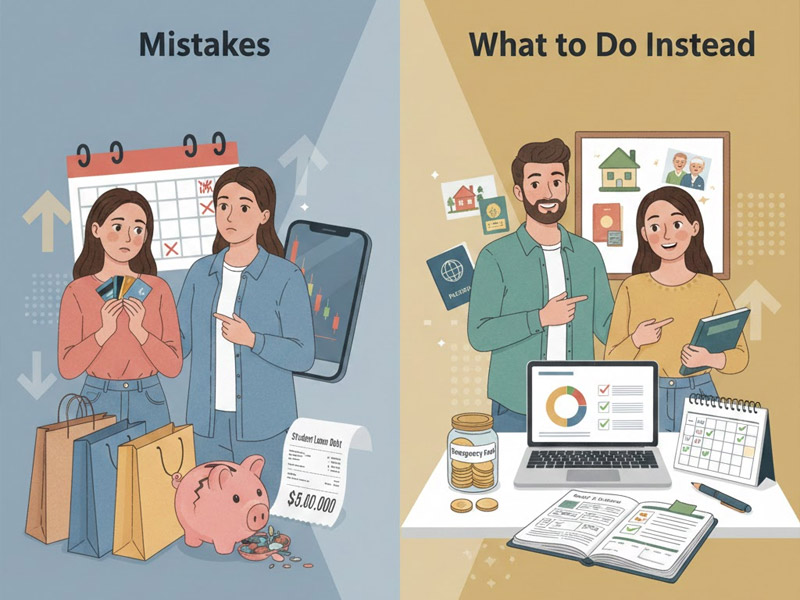
Personal Finance Mistakes to Avoid in Your 20s and 30s (and What to Do Instead)

Your 20s and 30s are some of the most financially important years of your life. Not because you need to be “rich” by then—but because the money habits you build (or don’t build) during these decades can shape your entire future.

The good news? Most financial mistakes are completely avoidable once you know what to look out for. Below are the most common personal finance mistakes people make in their 20s and 30s—and smart alternatives that set you up for long-term stability and wealth.


1. Living Like Your Income Will Always Grow

In your 20s/30s, promotions, job changes, and salary increases can happen quickly. Many people assume income will keep rising—and start spending in advance.

Why it’s a mistake:

If income stops growing (or drops due to layoffs, illness, or life changes), lifestyle expenses become a trap.

What to do instead:

  • Increase savings every time your income increases
  • Keep lifestyle upgrades intentional, not automatic
  • Use a rule like: 50% of raises go to savings/investing

2. Not Having an Emergency Fund

Many people skip emergency savings because it feels slow or “unnecessary”… until life happens.

Why it’s a mistake:

Without emergency funds, you’ll rely on credit cards, loans, or family when things go wrong.

What to do instead:

Aim for:

  • $1,000 starter emergency fund
  • Then build up to 3–6 months of expenses

Even saving $50–$100/week creates real protection.


3. Using Credit Cards Like Free Money

Credit cards can be helpful tools, but they can also silently destroy your finances if misused.

Why it’s a mistake:

Interest rates can exceed 20–30%, making it extremely hard to escape debt.

What to do instead:

  • Only spend what you can pay off monthly
  • Automate full payment
  • If you have debt: prioritize paying it down aggressively before investing heavily

4. Ignoring Retirement Because It Feels Far Away

This is one of the biggest mistakes young adults make—even smart, successful ones.

Why it’s a mistake:

You lose the biggest advantage you’ll ever have: time + compound growth.

What to do instead:

Start immediately—even small amounts:

  • If your employer offers a match, contribute at least enough to get it
  • Aim for 10–15% of income over time

Starting early turns “small investing” into “huge outcomes.”


5. Buying a Car That Eats Your Budget

In your 20s/30s, a new car can feel like a milestone purchase.

Why it’s a mistake:

Cars lose value fast and can lock you into expensive payments, insurance, fuel, and maintenance.

What to do instead:

  • Buy reliable used cars
  • Keep car payment under 10–15% of monthly take-home pay
  • Avoid long loan terms (72–84 months) whenever possible

6. Not Tracking Spending (Even a Little)

Many people think budgeting means restriction. It doesn’t. It means awareness.

Why it’s a mistake:

If you don’t track money, you’ll wonder where it went every month—especially as expenses grow.

What to do instead:

Use a simple structure:

  • Fixed costs: rent, bills, groceries
  • Financial goals: savings, debt payoff
  • Lifestyle: fun, travel, dining

Even a basic monthly spending check-in can change everything.


7. Taking on Student Loans Without a Plan

Student debt is common—but many people treat it like permanent debt.

Why it’s a mistake:

It delays saving, investing, homeownership, and financial freedom.

What to do instead:

  • Know your interest rate(s)
  • Pay more than minimum if possible
  • Consider refinancing (when safe/appropriate)
  • Use windfalls (bonuses/tax refunds) strategically

8. Choosing Lifestyle Over Financial Stability

Trips, shopping, dining, subscriptions—these add up quickly.

Why it’s a mistake:

Small daily spending can quietly block major financial goals.

What to do instead:

Pick your “yes” categories:

  • Maybe you love travel
  • Maybe you love eating out
  • Maybe you love tech gadgets

But you don’t need to say yes to everything.


9. Delaying Insurance Until It’s Too Late

Many people ignore insurance because it feels boring—until they face a major expense.

Why it’s a mistake:

One medical event, accident, or emergency can wipe out savings.

What to do instead:

At minimum consider:

  • Health insurance (non-negotiable)
  • Car insurance (required in most places)
  • Renters insurance (cheap but powerful)
  • Life insurance (important if others depend on your income)

10. Not Building Credit the Right Way

Some people ignore credit completely; others build it badly.

Why it’s a mistake:

Credit impacts loan approvals, rental applications, interest rates, and even insurance pricing in some places.

What to do instead:

  • Pay on time always
  • Keep utilization low (under 30%, ideally under 10%)
  • Don’t open too many accounts too quickly

Credit score growth is slow—but worth it.


11. Not Negotiating Salary (or Asking for Raises)

Many people feel uncomfortable negotiating, especially early in their careers.

Why it’s a mistake:

Salary affects everything: savings, investing, retirement, lifestyle, and long-term wealth.

What to do instead:

  • Research market salary ranges
  • Track achievements throughout the year
  • Ask clearly: “Based on my performance, I’d like to discuss a raise to X.”

One negotiation can add tens of thousands to lifetime income.


12. Comparing Your Financial Life to Others

Social media can make it feel like everyone is ahead: buying homes, traveling constantly, driving luxury cars.

Why it’s a mistake:

You only see people’s highlights—not their debt, stress, or help from family.

What to do instead:

Measure progress against yourself:

  • Are you saving more than last year?
  • Do you have less debt?
  • Are you investing consistently?

That’s real success.


Final Thoughts: Your 20s and 30s Are for Building the Foundation

You don’t need a perfect financial life in your 20s or 30s. You just need a strong foundation:

  • emergency savings
  • manageable debt
  • increasing income
  • retirement contributions
  • consistent habits

Avoiding these common mistakes can put you ahead of most people—even if you’re starting late or rebuilding.

How to Set Financial Goals and Actually Reach Them

Setting financial goals sounds simple—save more money, pay off debt, invest for the future. But in real life, most people struggle with one important part: actually following through.

The truth is, financial success isn’t usually about earning a huge salary or having perfect discipline. It’s about having a clear plan, realistic goals, and a system that makes progress automatic.

In this article, you’ll learn exactly how to set financial goals (the right way) and how to reach them step-by-step—without burnout, confusion, or giving up halfway.


Why Financial Goals Matter More Than Motivation

Motivation fades fast. Goals don’t.

When you create strong financial goals, you give your money a purpose. Instead of wondering where your paycheck went each month, you start making intentional choices.

Financial goals help you:

  • Focus your spending on what matters
  • Avoid impulse purchases and lifestyle inflation
  • Reduce financial stress
  • Make progress even with a tight income
  • Build long-term wealth

Step 1: Start With Your “Why”

Before you write numbers down, take a minute to figure out your true reason.

Ask yourself:

  • Why do I want to save money?
  • What would a better financial future look like?
  • What would I change if money wasn’t stressful?

Maybe your “why” is:

✅ freedom
✅ peace of mind
✅ traveling more
✅ buying a home
✅ quitting your job someday
✅ providing stability for family

Your goals will be easier to stick to when they’re tied to something meaningful—not just a random target number.


Step 2: Pick the Right Type of Financial Goals

Most people set goals too vaguely:
“I want to save more.”

That’s not a goal—it’s a wish.

A real financial plan includes three types of goals:

1) Short-Term Goals (0–12 months)

These goals are fast wins that build momentum.

Examples:

  • Save $1,000 emergency fund
  • Pay off one credit card
  • Build a monthly budget
  • Start a sinking fund for car repairs

2) Mid-Term Goals (1–5 years)

These take planning and consistent effort.

Examples:

  • Save for a house down payment
  • Pay off all debt
  • Replace your car with cash
  • Save for a wedding or major trip

3) Long-Term Goals (5+ years)

These are life-changing goals.

Examples:

  • Build retirement investments
  • Become financially independent
  • Pay off your mortgage early
  • Build generational wealth

Step 3: Use the SMART Goal Method (But Make It Financial)

SMART goals are popular because they work.

A strong financial goal should be:

  • Specific
  • Measurable
  • Achievable
  • Relevant
  • Time-based

Example: Weak vs Strong Goal

❌ Weak: “I want to save money.”
✅ Strong: “I will save $3,000 for an emergency fund in 10 months by saving $300 per month.”

Now it’s clear:

  • what you’re doing
  • how much you need
  • how long it will take
  • what action you’ll take monthly

Step 4: Know Your Starting Point (This Is Where Most People Skip)

You can’t plan a journey without knowing where you’re beginning.

Take an honest look at:

  • total income
  • fixed monthly expenses
  • variable spending
  • debt balances and interest rates
  • current savings
  • investments (if any)

Even if it’s messy, clarity is power.

Tip: Start by tracking spending for 30 days or reviewing 2–3 bank statements. Patterns show up quickly.


Step 5: Break Big Goals Into Small Monthly Targets

A goal you can’t break down is a goal you won’t reach.

Once you set the goal, divide it into manageable parts.

Example:

Goal: Save $6,000 in 12 months
Monthly target: $500
Weekly target: $125
Daily target: about $17

Breaking it down makes it feel doable and measurable.


Step 6: Automate Your Progress (The Secret to Reaching Goals)

If you only save money “when you remember,” your progress will always be inconsistent.

Automation removes the need for willpower.

You can automate:

✅ savings transfers (every payday)
✅ retirement contributions
✅ debt payments above minimum
✅ bill payments to avoid late fees

Even $25 or $50 per paycheck adds up over time.

Rule: Pay yourself first—before spending.


Step 7: Expect Obstacles and Plan for Them

A big reason people fail financially isn’t laziness—it’s surprise expenses.

That’s why you should build buffers into your plan.

Use “sinking funds”

Sinking funds are small savings categories for predictable expenses:

  • car maintenance
  • holidays
  • birthdays
  • annual subscriptions
  • back-to-school costs
  • medical expenses

When these expenses show up, you’ll already be prepared—and won’t derail your financial goals.


Step 8: Track Progress the Right Way (Weekly > Yearly)

Most people only check their finances when they feel stressed.

Instead, schedule a short “money check-in.”

Weekly (10 minutes):

  • check account balance
  • review spending categories
  • adjust budget if needed

Monthly (30 minutes):

  • track savings progress
  • record debt balances
  • celebrate wins (important!)

Tracking keeps you in control and allows small corrections before problems grow.


Step 9: Celebrate Milestones to Stay Motivated

Progress is a process—so don’t wait until the finish line to feel successful.

Celebrate milestones like:

  • first $500 saved
  • first debt paid off
  • first month under budget
  • first $1,000 invested

Celebrating keeps you motivated and teaches your brain:
financial progress feels good.


Step 10: Adjust Goals as Life Changes (No Shame)

Sometimes you’ll fall behind—and that’s normal.

If income drops, expenses rise, or emergencies happen, you don’t quit. You adjust.

A better timeline is still progress.

Remember:
✅ consistency beats perfection
✅ slow progress beats no progress


Final Thoughts: Financial Goals Work When They Become a System

Setting goals isn’t about writing numbers in a notebook and hoping for the best.

To actually reach financial goals, you need:

  1. Clear goals
  2. A strong “why”
  3. A monthly breakdown
  4. Automation
  5. Regular tracking
  6. Flexibility

If you do those consistently, your goals stop being dreams—and start becoming your reality.

Navigating Life’s Crossroads: Why Financial Literacy is Your Ultimate GPS

Life is a series of transitions, from the exciting to the challenging. Getting your first job, moving to a new city, buying a home, getting married, having children, changing careers, or even navigating a major health event – each of these milestones comes with significant financial implications that, if not properly managed, can quickly turn a moment of joy into a source of stress. This is where financial literacy for life transitions becomes your ultimate GPS, guiding you through unfamiliar territory with confidence.

Most financial advice focuses on general principles: save more, spend less, invest wisely. While invaluable, these broad strokes often miss the specific, complex financial nuances that arise during life’s major shifts. Understanding these unique financial landscapes before you enter them can be the difference between thriving and just barely surviving.

The Hidden Costs of Milestones

Let’s explore some common life transitions and why a tailored financial understanding is crucial:

1. First Job / Moving Out: Beyond the Rent Check

The excitement of independence often blinds young adults to the full cost of living on their own. It’s not just rent; it’s utilities, groceries, transportation, health insurance (if not provided by an employer), furnishing a place, and the often-overlooked “setup costs” like security deposits. Financial literacy here means understanding budgeting, setting up emergency savings, managing student loan payments, and beginning to build credit responsibly.

2. Marriage / Merging Finances: Two Become One (Bank Account)

Combining lives means combining financial philosophies, debts, and assets. This transition requires open communication, shared goal setting, and often, difficult conversations about past financial habits. Key literacy areas include creating a joint budget, deciding on joint vs. separate accounts, understanding each other’s credit scores, managing existing debts, and updating beneficiaries on financial accounts. It’s about building a unified financial vision for your shared future.

3. Buying a Home: More Than Just the Mortgage Payment

The down payment and monthly mortgage are just the tip of the iceberg. Homeownership comes with property taxes, homeowner’s insurance, maintenance costs (often 1-3% of the home’s value annually), potential HOA fees, and closing costs that can add thousands to the initial expense. Financial literacy for homebuyers includes understanding different mortgage types, assessing affordability beyond the monthly payment, saving for a substantial emergency fund, and knowing how to budget for ongoing home expenses.

4. Having Children: The Priceless Addition with a Price Tag

Raising a child is one of life’s greatest joys, but it’s also a significant financial undertaking. From diapers and formula to childcare, education savings, increased healthcare costs, and extracurricular activities, the expenses add up rapidly. Financial preparation involves adjusting budgets for new recurring costs, understanding tax credits for dependents, exploring college savings plans (like 529s), and critically, updating life insurance and wills to protect your growing family.

5. Career Change / Entrepreneurship: The Leap of Faith

Whether you’re moving to a new industry or starting your own business, a career transition often involves a period of reduced or unstable income. Financial literacy here means building a robust emergency fund (ideally 6-12 months of living expenses), understanding unemployment benefits (if applicable), budgeting for potential training or startup costs, and for entrepreneurs, learning about business finance, taxes, and cash flow management.

6. Retirement Planning: The Grand Finale (and New Beginning)

While retirement planning starts early, the years immediately preceding and during retirement are critical. This transition involves shifting from accumulating assets to drawing them down. Financial literacy means understanding Social Security benefits, managing investment withdrawals strategically to minimize taxes, navigating healthcare costs in retirement (including Medicare and long-term care), and ensuring your estate plan is in order. It’s about ensuring your nest egg lasts as long as you do.

The Lifelong Learner Advantage

The common thread through all these transitions is the need for proactive learning and planning. Financial literacy isn’t a one-time course; it’s a continuous process of acquiring knowledge and adapting strategies as your life unfolds.

By understanding the financial landscape of an upcoming life transition, you gain:

  • Reduced Stress: Knowing what to expect and having a plan alleviates anxiety.
  • Better Decision-Making: You make informed choices, avoiding costly mistakes.
  • Increased Resilience: You build buffers to withstand unexpected challenges.
  • Empowerment: You take control of your financial destiny, rather than feeling controlled by circumstances.

Don’t wait for a life event to force your hand. Anticipate, educate yourself, and plan. Treat financial literacy as your essential companion for every chapter of your life’s journey. It’s the tool that transforms uncertainty into opportunity, allowing you to embrace each transition with an open heart and a well-prepared wallet.

Your Career: The Undervalued Superpower in Your Financial Toolkit

When we talk about personal finance, the conversation almost always gravitates towards budgeting, investing, and cutting expenses. We obsess over saving $5 on a latte or optimizing our investment fees down to a fraction of a percent. While these strategies are undoubtedly important, they often overshadow the single most powerful financial asset you possess: your career.

Think about it: a one-time $5 saving is just that—$5. A $10,000 raise, however, is $10,000 every single year. It’s $10,000 more available for saving, investing, or spending, multiplied by the decades you’ll work. This profound difference highlights why focusing on your career — your ability to earn income — is often the fastest and most impactful way to accelerate your financial goals.

The Power of Income Acceleration

Consider two individuals, both 30 years old, with similar expenses and savings rates.

  • Person A diligently saves 10% of their $50,000 salary ($5,000/year) and focuses on finding the best interest rates for their savings.
  • Person B also saves 10% of their $50,000 salary, but spends their energy on upskilling, networking, and strategically changing roles to increase their income. Over the next five years, Person B’s income grows by an average of 10% annually, reaching over $80,000.

While Person A is optimizing pennies, Person B is adding thousands of dollars to their income, which directly translates to thousands more in savings and investments. The compound effect of these increased contributions will, over time, dwarf any minor savings on expenses. Your income isn’t just a number; it’s the fuel that powers your entire financial engine.

Investing in Human Capital: Your Best Bet

Just as you invest in stocks or real estate, you should actively invest in your “human capital” — your skills, knowledge, experience, and network. This investment yields dividends in the form of higher salaries, better job opportunities, and greater career satisfaction.

Here’s how to treat your career like the powerhouse asset it is:

  1. Continuous Learning and Skill Acquisition: The job market is constantly evolving. What was valuable five years ago might be commoditized today. Identify in-demand skills in your industry (or an industry you want to enter) and dedicate time and resources to acquiring them. This could mean online courses, certifications, workshops, or even self-study. Think of it as upgrading your personal software.
  2. Strategic Networking: Your network isn’t just about finding your next job; it’s about staying informed, gaining mentorship, and discovering new opportunities. Cultivate genuine relationships with people in your field and adjacent industries. Attend conferences, join professional organizations, and engage on platforms like LinkedIn. These connections can open doors you didn’t even know existed.
  3. Negotiation is Key: Many people leave significant money on the table by not negotiating their salaries during job offers or annual reviews. Research market rates for your role and experience level. Practice your negotiation skills. Remember, every extra dollar you negotiate today compounds over your entire career. A $5,000 difference in your starting salary can translate to hundreds of thousands of dollars over a 30-year career.
  4. Side Hustles with Scaling Potential: While a side hustle can provide immediate extra income, think strategically. Can your side hustle evolve into something more significant? Can it teach you new skills that make you more valuable in your primary job? Can it eventually scale into a full-fledged business? Focusing on side hustles that build skills or offer long-term growth potential makes them an investment, not just a temporary income boost.
  5. Proactive Career Management: Don’t wait for your company to lay out your career path. Take ownership. Regularly assess your career goals, identify potential growth opportunities, and seek out projects that expand your skill set. If your current role isn’t offering the growth you need, be prepared to strategically look elsewhere. Sometimes, the most significant salary jumps come from changing companies or even industries.

Beyond the Paycheck: Intangible Returns

Investing in your career offers more than just financial returns. A fulfilling career can significantly contribute to your overall well-being. When you’re engaged, challenged, and growing, it spills over into other areas of your life. This intrinsic value, while harder to quantify, is an equally important return on your human capital investment.

Conclusion: Shift Your Financial Mindset

While diligent budgeting and smart investing are foundational to financial health, it’s time to elevate your career to its rightful place as a primary financial asset. Stop thinking of your job merely as a means to an end, and start viewing it as a dynamic, powerful engine that can propel you toward your financial aspirations faster than any other single factor. Invest in yourself, negotiate your worth, and proactively manage your professional journey. The returns on this investment will be transformational.

The Boring Middle: How to Survive the Longest Stretch of Your Financial Journey

The beginning of a financial journey is electric. There is a rush of adrenaline when you first download a budgeting app, the dopamine hit of paying off your smallest credit card, and the novelty of seeing your first few dollars of dividends hit your account.

Then, eventually, you reach the “Boring Middle.”

The Boring Middle is that vast, multi-decade expanse between the excitement of getting started and the victory lap of retirement. You’ve automated your investments, your debt is gone or manageable, and your lifestyle is stable. Now, there is nothing left to do but wait. And for most people, waiting is the hardest part of personal finance.

The Psychological Trap of the Plateau

In the beginning, your effort correlates directly with your results. If you cut your grocery bill by $200, you see $200 more in your savings account immediately. But in the middle, the math shifts. Your contributions start to matter less than the market’s fluctuations.

When you have $10,000 invested, a $5,000 contribution increases your net worth by $50\%$. When you have $500,000 invested, that same $5,000 contribution only moves the needle by $1\%$. This can feel demoralizing. It feels like you are running on a treadmill—putting in massive effort but seemingly standing still.

This plateau is where most people quit. They get bored, they start “tinkering” with their portfolio to see some action, or they succumb to lifestyle creep, convinced that since they aren’t “rich” yet, they might as well spend the money now.

Redefining Growth: It’s Not Just About the Numbers

To survive the Boring Middle, you have to stop looking at your bank account as the primary scoreboard for your life. If you judge your success solely by your month-to-month net worth, you will eventually burn out.

Instead, shift your focus toward Time Wealth and Skill Wealth.

During these years, your greatest asset isn’t just the money in your 401(k); it’s your ability to refine your lifestyle. This is the time to ask: “If I am going to be in this holding pattern for 15 years, how do I make these years the most enjoyable version of my life?” ### Strategies to Navigate the Middle

If you find yourself feeling restless in the financial doldrums, use these three strategies to stay the course without losing your mind.

1. Automate and Forget

The biggest mistake people make in the Boring Middle is checking their accounts too often. When you check your balance daily, you see the “noise” of the market. When you check it once a year, you see the “signal” of growth.

Set up your “Financial Flywheel”:

  • Automate your 401(k) and IRA contributions.
  • Set a recurring transfer for your brokerage account.
  • Automate your bill payments.

Once the system is built, your job is no longer to manage money; it is to ignore it. The less you interact with your investments, the less likely you are to make emotional decisions that sabotage your long-term gains.

2. Beware the “Wealth Illusion”

As you move through your career, your income will likely rise. In the Boring Middle, this presents a danger known as lifestyle creep. You start buying the nicer car, the bigger house, or the premium subscription services because “you can afford it.”

While you should absolutely enjoy your money, be wary of increasing your fixed costs to the point where you extend the Boring Middle by another decade. A helpful rule of thumb is the 50% Rule: Every time you get a raise or a bonus, commit 50% to your future (savings/investments) and 50% to your present (spending/lifestyle). This allows you to live better today while simultaneously accelerating your path to the finish line.

3. Gamify the Process

If the lack of drama is killing your motivation, create your own milestones. The gap between $100,000 and $1,000,000 is too wide to stay excited about. Break it down into “mini-goals”:

  • The “Coast FIRE” milestone (where you don’t need to add another penny to retire comfortably at 65).
  • The point where your annual investment returns exceed your annual contributions.
  • The “100-Day No-Spend” challenges on specific categories.

The Power of Compound Interest (The Hidden Engine)

The Boring Middle is where the heavy lifting of compound interest actually happens. Think of it like a plane taking off. The beginning is the loud, fuel-heavy ascent. The end is the landing. The middle is the long, quiet cruise at 35,000 feet. It feels like you aren’t moving, but you are covering thousands of miles.

The math of the middle is non-linear. The growth you experience in year 20 of your journey will likely be greater than the total growth of years 1 through 15 combined. You are building a snowball; in the middle, the snowball is just starting to get heavy enough to pick up its own momentum.

Conclusion: Embrace the Quiet

The Boring Middle is actually a sign of success. It means you’ve moved past the crisis mode of living paycheck-to-paycheck. It means your systems are working.

The goal of personal finance isn’t to be “busy” with money forever. The goal is to reach a point where money is a background process in your life, allowing you to focus on the things that actually matter: your health, your relationships, and your purpose.

Stop looking for excitement in your portfolio. If you want excitement, go skydiving or start a hobby. Let your money be boring, so your life can be interesting.

Why You Should Not Pay Only the Minimum on Your Credit Card

Credit cards can be useful financial tools, but only when used responsibly. One of the most common—and most expensive—mistakes people make is paying only the minimum payment shown on their monthly statement. While it may seem convenient, this habit can seriously harm your financial health.

1. Minimum payments are designed to benefit the bank, not you

The minimum payment is usually between 1% and 5% of your total balance, plus interest and fees. With such a small payment, your debt barely decreases.

Why?
Because most of what you pay goes toward interest, not the principal.

This means you can spend years paying off a debt that could be eliminated much faster.

2. Interest keeps compounding and makes your debt grow

Credit cards often have very high interest rates, sometimes between 30% and 100% annually, depending on the country. When you pay only the minimum, the bank continues charging interest on the remaining balance.

The result:

  • Your debt grows or decreases very slowly
  • You end up paying many times more than you originally spent

3. Your available credit shrinks

When you carry a high balance for long periods:

  • Your credit line stays occupied
  • You have less room for emergencies or necessary purchases
  • Your credit utilization ratio may rise, which can harm your credit score

Banks often interpret high credit usage as a sign of financial stress.

4. It can negatively impact your credit score

Paying the minimum keeps you from becoming delinquent, but it can still hurt you by:

  • Keeping your credit utilization high
  • Making lenders see you as a higher-risk customer
  • Limiting your chances of getting loans with good interest rates

5. It traps you in a cycle of debt

Paying only the minimum gives the illusion that your debt is manageable. But in reality, it can create a debt cycle that is difficult to escape:

  1. You spend
  2. You pay a small amount
  3. Interest grows
  4. Your balance barely drops
  5. You continue relying on the card

6. You waste money that could be used for your goals

Credit card interest is one of the most expensive and least productive expenses.
Instead of giving that money to the bank, you could be:

  • Investing
  • Saving
  • Improving your education
  • Improving your lifestyle

Paying only the minimum is essentially throwing away part of your income every month.

What to do instead?

Always pay more than the minimum

Even paying double or triple the minimum accelerates debt reduction.

Create a repayment plan

Decide how much you can reasonably pay each month to eliminate the debt faster.

Avoid using the card while paying it down

Otherwise, your balance will never truly decrease.

Consider refinancing at a lower interest rate

Some banks offer balance transfers or structured payment plans at lower rates.

Build an emergency fund

This helps you avoid relying on credit for unexpected expenses.