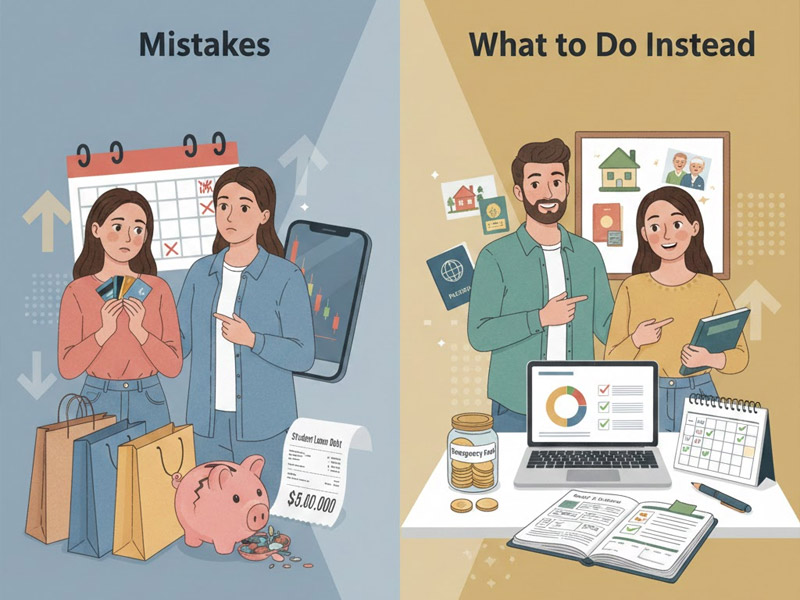
You got the promotion. Your salary jumped from $60,000 to $80,000. You celebrated, felt relief, maybe even splurged a little. Then six months later, you checked your savings account and realized something unsettling: despite earning 33% more, you weren’t actually saving any more money. In fact, you might be saving less.
Welcome to lifestyle creep, the silent wealth destroyer that makes earning more feel like running faster on a treadmill. It’s the phenomenon where your spending rises in lockstep with your income, ensuring that no matter how much you earn, you’re always living paycheck to paycheck—just with nicer stuff.
How Lifestyle Creep Actually Works
Lifestyle creep doesn’t announce itself. There’s no moment where you consciously decide to spend all your raise. Instead, it happens through a thousand small decisions that feel completely reasonable in isolation.
When you were making $60,000, you lived in a modest apartment, brought lunch to work most days, flew economy, and thought carefully about purchases over $100. These weren’t sacrifices—they were just your normal life.
But once that $80,000 salary hits your account, subtle shifts begin. Your current apartment suddenly feels cramped. Why not upgrade to that nicer building with the gym and parking? It’s only $300 more per month, and you can afford it now. That’s the first decision that feels entirely justified.
Then the food delivery apps become more frequent. You’re working harder now, earning more, so you deserve the convenience. Your weekly grocery budget doesn’t change, but your monthly spending does—$200 here, $150 there.
Your car is paid off, but it’s five years old. You start browsing newer models. Nothing crazy, just something more reliable. Next thing you know, you have a $450 monthly payment that will last five years.
None of these decisions alone breaks your budget. Each one is rational. But together, they create a new baseline where your $80,000 salary feels as tight as your $60,000 salary did before. The treadmill just got faster.
The Math That Should Terrify You
Let’s run the numbers on what lifestyle creep actually costs over a career. We’ll compare two people who both start at $60,000 and reach $120,000 by age 45 through regular raises and promotions.
Person A – Lifestyle Creep Victim:
- Maintains a consistent 10% savings rate throughout career
- As income rises, spending rises proportionally
- At $60,000: saves $6,000 annually. At $120,000: saves $12,000 annually
Person B – Lifestyle Maintenance:
- Maintains the same $54,000 annual spending from their $60,000 salary days
- Every raise goes directly to savings and investments
- At $60,000: saves $6,000 annually. At $120,000: saves $66,000 annually
Over a 25-year career, assuming 7% investment returns, Person A accumulates roughly $850,000. Person B accumulates over $2.4 million. Same starting salary. Same ending salary. A $1.5 million difference.
That’s not a typo. The difference between letting your lifestyle expand and keeping it relatively constant is retirement in your 50s versus working into your late 60s. It’s financial independence versus financial dependence. It’s options versus obligations.
The Psychological Traps That Enable Lifestyle Creep
Lifestyle creep persists because it exploits several psychological vulnerabilities that make it feel completely rational in the moment.
The Reward Trap: After years of delayed gratification and hard work to get that raise, spending more feels like a deserved reward. The problem is that rewards become baseline expectations. The $300 nicer apartment stops feeling like a luxury within three months and starts feeling like what you need. You’ve permanently raised your baseline.
The Comparison Trap: As you get promoted, your peer group changes. You’re now working alongside people who make similar money but who have been at that income level longer. Their lifestyle—the cars they drive, the neighborhoods they live in, the restaurants they frequent—becomes your reference point. Suddenly your perfectly adequate life feels inadequate.
The Incremental Trap: No single decision feels significant. It’s not like you’re buying a yacht. It’s just $15 more for the premium streaming service. Just $80 for the better gym membership. Just $50 for the meal kit subscription. Each decision is defensible, but they accumulate into hundreds of dollars monthly without triggering your mental alarms.
The Efficiency Trap: As your career advances and your time becomes more valuable, outsourcing tasks feels rational. Housecleaning, lawn care, meal prep, grocery delivery—each saves time. But if you’re not actually using that saved time for something that advances your goals, you’re just paying money to watch more Netflix.
The Boiling Frog Trap: The temperature rises so gradually you don’t notice. You don’t wake up one day and decide to spend $2,000 more per month. It happens over years through dozens of small adjustments. By the time you realize your entire raise disappeared, the spending has become so ingrained in your routine that cutting back feels like deprivation.
What Lifestyle Creep Actually Costs You
The financial cost is obvious—millions of dollars over a lifetime. But lifestyle creep extracts other tolls that compound the damage.
Career Flexibility: When your spending matches your income, you’re locked into your current job and salary level. Want to take a risk on a startup? Can’t afford the pay cut. Hate your boss but love your work? Too bad, you need this salary. Dream of a career change? Not possible—your mortgage requires this income. Lifestyle creep trades long-term freedom for short-term comfort.
Stress Multiplication: Living at the edge of your income means every unexpected expense becomes a crisis. The car repair, the medical bill, the home repair—these aren’t minor inconveniences but genuine threats to your financial stability. People earning six figures shouldn’t be stressed about a $1,500 emergency, but millions are because their lifestyle leaves no margin for error.
Relationship Strain: Money stress is consistently cited as a leading cause of relationship problems. When both partners are locked into high-stress jobs to maintain an expensive lifestyle neither of them particularly values but both feel unable to change, resentment builds. You’re working harder to maintain a life you don’t have time to enjoy.
Retirement Delay: The most expensive cost is time. Every year you need to work because you can’t afford to retire is a year you’re not getting back. The irony is that many people work jobs they don’t particularly love to maintain lifestyles that don’t particularly make them happy, postponing the retirement that could actually provide the time and freedom they crave.
Hedonic Treadmill Acceleration: Perhaps worst of all, lifestyle creep accelerates the hedonic treadmill without ever letting you get off. Each upgrade provides a brief dopamine hit that quickly normalizes. The nicer apartment stops feeling nice. The newer car becomes just your car. But now you’re stuck with higher expenses that don’t deliver ongoing happiness. You’ve permanently raised your cost of living for a temporary boost in satisfaction.
Strategies to Combat Lifestyle Creep
Awareness isn’t enough. You need systems that make maintaining your lifestyle the default rather than requiring constant willpower.
The 50-30-20 Adjustment Rule: When you get a raise, immediately allocate it before lifestyle inflation begins. A reasonable split: 50% to savings and investments, 30% to lifestyle improvement, 20% to taxes (if not already withheld). This lets you enjoy increased income while dramatically accelerating wealth building. On a $20,000 raise, that’s $10,000 to savings, $6,000 to lifestyle, $4,000 to taxes—you improve your life while securing your future.
Automate Before You Celebrate: The day your raise takes effect, increase your automatic retirement contributions and savings transfers. Set it up so the money never touches your checking account. What you don’t see, you won’t miss. If your take-home pay increases by $1,000 monthly, immediately set up a $500 automatic transfer to savings. You can still enjoy the other $500, but half your raise is protected from lifestyle creep.
Identify Your Non-Negotiables: Some spending genuinely improves your quality of life. Maybe that’s living alone instead of with roommates. Maybe it’s a short commute. Maybe it’s high-quality food or regular travel. Identify the 2-3 things that actually matter to you, invest in those when your income rises, and stay frugal everywhere else. Lifestyle creep is dangerous when it’s unconscious spending across all categories.
The One-Year Delay Rule: When you get a significant raise, commit to living on your old salary for one full year. Bank the entire increase. This serves two purposes: you prove to yourself that you don’t need the extra money to be happy, and you build a substantial financial cushion. After one year, if you want to increase spending, you’ve already secured a year’s worth of savings from that raise.
Track Your Baseline: Know what you spent monthly before each raise. Specifically track the creep. Six months after a raise, compare your spending to your pre-raise baseline. This creates accountability and makes the creep visible. Most people have no idea their spending increased by $800 monthly because no single decision cost $800.
Choose Growth Over Stuff: If you’re going to spend more, bias toward experiences and education over material possessions. The research is clear that experiences provide more lasting satisfaction than things. Learning new skills or traveling creates memories and growth. A nicer couch just creates furniture you stop noticing after a month.
The Lifestyle Inflation Audit
To see if lifestyle creep has already infected your finances, conduct this audit:
- Pull up your spending from five years ago and compare it to today (adjusting for inflation)
- Calculate what percentage of your income you saved five years ago versus today
- List every recurring subscription and monthly expense—then ask if you’d sign up for each one today at current prices
- Identify which lifestyle upgrades you made in the last few years that genuinely improved your happiness versus those that just raised your baseline
- Calculate how much you would have saved if your spending had remained constant over those five years
That last number is particularly sobering. It represents the retirement you postponed, the financial security you traded, and the career flexibility you sold in exchange for a lifestyle you probably don’t value as much as you think.
The Alternative: Intentional Lifestyle Design
The opposite of lifestyle creep isn’t deprivation—it’s intention. It’s consciously deciding what you value and investing in that while remaining frugal everywhere else. It’s understanding that every dollar you spend today is a dollar that can’t compound into long-term wealth and freedom.
Consider two scenarios for your future self:
Scenario A: You’re 55, still working because you need the income, living in a nice house with nice stuff, stressed about money despite a six-figure salary, unable to retire for another 10-15 years, constrained in your career choices because you need to maintain your income.
Scenario B: You’re 55, financially independent with the option to retire or work because you want to, living comfortably but not extravagantly, stress-free about money, free to pursue projects or careers you find meaningful regardless of pay, able to help your children or causes you care about.
The difference between these scenarios isn’t determined by how much you earn. It’s determined by what you do with each raise. Most people sleepwalk into Scenario A because lifestyle creep is the path of least resistance. Each small decision feels rational. The cumulative effect is devastating.
The good news is that you get to choose. Every time your income increases, you face a fork in the road. You can let your lifestyle automatically expand to match your income, or you can consciously direct that increase toward building the future you actually want.
The real cost of lifestyle creep isn’t just the money. It’s the decade of your life you’ll spend working because you can’t afford to stop. It’s the career opportunities you’ll pass up because you’re locked into your current income. It’s the stress and constraint that comes from living at the edge of what you earn, no matter how much that is. The question isn’t whether you can afford the upgrade. The question is whether the upgrade is worth what you’re giving up.